
Why Do Customers Need the TM40 Travel Assembly? When It Is Used, What It Does, and What It Changes


Автор
Эбби
Компания Guangzhou Rito Engineering Machinery Equipment Co., Ltd., расположенная в Гуанчжоу, Китай, является ведущим производителем и дистрибьютором гидравлических насосов, редукторов, поворотных двигателей и главных регулирующих клапанов для землеройной техники. Мы поставляем оригинальные, OEM-запчасти и высококачественные запчасти для вторичного рынка.
Мы стремимся постоянно делиться своим опытом в области строительной техники и гидравлических систем экскаваторов. Наша цель — помочь вам глубже понять принципы работы и применения оборудования, что позволит вам работать эффективнее, а также продемонстрировать наши профессиональные знания и возможности. Приглашаем вас узнать о нас больше.
Выбирая нас, вы получаете лучшее обслуживание, самые выгодные цены и самого надежного поставщика!
Мари Р. Уинтерс


Quick Answer
Key Takeaways
- A travel drive is not a wear item you can defer: when it fails, the machine stops earning completely.
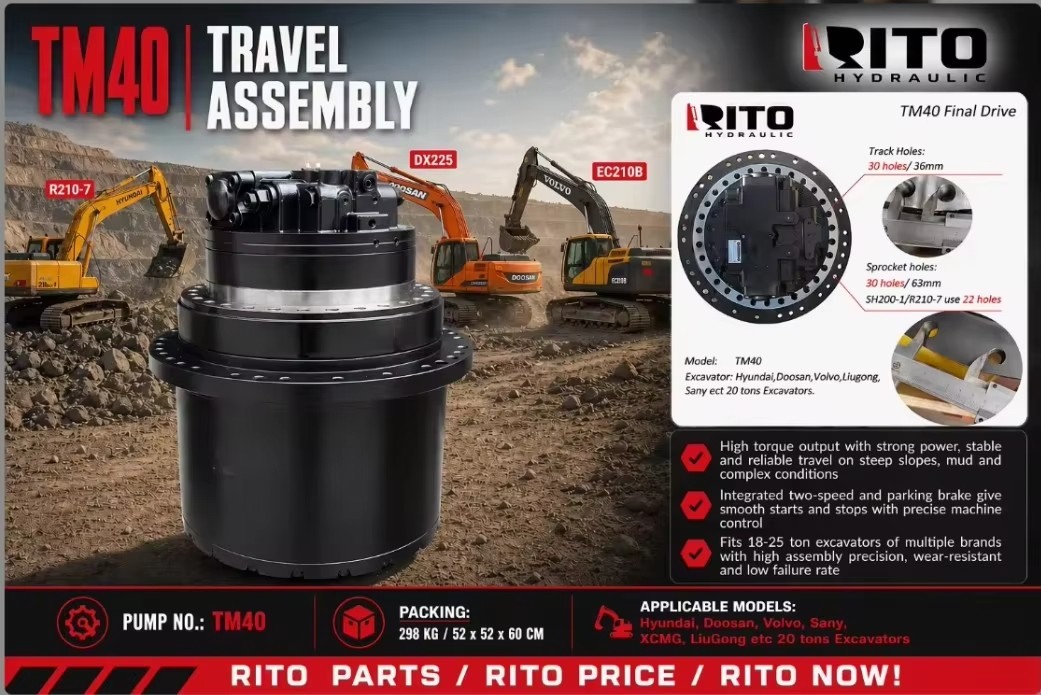
- The TM40 serves 18–25 tonne machines across Hyundai, Doosan, Volvo, Sany, XCMG and LiuGong — one drive, several brands.
- It provides high torque travel on slopes and mud, with an integrated two-speed and parking brake.
- The compatibility key is the bolt pattern: 30 track holes at 36 mm and 30 sprocket-hub holes at 63 mm, while SH200-1 and R210-7 use a 22-hole hub.
- For a mixed-brand fleet, standardising on one assembly means fewer part numbers, simpler stock and faster swaps.
- The customer's real gain is measured in hours back in production and fewer repeat repairs — not in the price of the part.
Table of Contents
- 1. Why a Customer Needs a Travel Assembly at All
- 2. When a TM40 Goes on Your List
- 3. What the TM40 Actually Does
- 4. What It Changes for the Customer
- 5. One Drive, Many Brands: Why Fleets Standardise
- 6. What to Confirm Before You Order
- 7. FAQ
- 8. Get Your TM40 Confirmed
1. Why a Customer Needs a Travel Assembly at All
Start with what the part sits between. On any tracked excavator, each side of the undercarriage carries a travel assembly — also called the final drive or travel device. It contains a hydraulic travel motor, a planetary reduction gearbox and a brake, and it is the only thing that connects the machine's hydraulics to its tracks.
That creates a specific commercial risk which owners feel immediately: a travel drive is a single point of failure for the whole machine. If it fails, the excavator does not become less productive — it becomes immovable. It cannot be driven to a safe place, it cannot be loaded, and on a site with soft ground or a slope it cannot even be towed easily. Everything that was planned for that machine stops at the same moment.
| What a failed travel drive costs | Why it is worse than a normal breakdown |
|---|---|
| Production stops immediately | A machine that cannot move cannot dig, load or travel — the whole work front it served stalls with it |
| Recovery is awkward | Dragging a 20-tonne excavator out of mud or off a slope needs another machine and time |
| Purchase becomes urgent | Emergency buying means paying for availability and accepting whatever lead time you are offered |
So the honest answer to "why would a customer need one" is: you need it when the alternative is a machine, a crew and a site all standing still. That is the frame in which every other decision — repair or replace, OEM or aftermarket, which brand — should be made.
2. When a TM40 Goes on Your List
Customers arrive at this purchase through several different doors. In practice almost all of them look like one of these seven situations.
| Situation | What the customer is dealing with |
|---|---|
| 1. One track will not move | The machine will not track straight or will not move at all on one side — it is already immobilised |
| 2. Grinding or knocking from a final drive | Internal gear or bearing damage; the noise is getting worse and the customer knows what comes next |
| 3. Oil loss, milky or metallic oil | Seal failure or water ingress; the unit has been running dry or contaminated |
| 4. No climbing power, slipping on slopes | The machine cannot pull itself up a slope or recover traction in mud — production drops even though nothing has "failed" |
| 5. The high-speed range does not engage | Travel is slow to reposition, which quietly costs time on every single cycle of the job |
| 6. A failed repair, or a rebuilt unit that did not last | The customer has already spent once and is not willing to spend twice on the same problem |
| 7. Planned replacement before a big job | A unit that is clearly near the end of its life, being changed on the customer's schedule rather than on site |
Notice that only the first of those is a dramatic failure. Situations 4, 5 and 7 are where the smart money moves — the customer replaces a drive while it is still working, because a machine that climbs properly and repositions quickly is more productive than one that is merely still running. If the fault appears on one side only, it is worth testing before buying: our guide to one-sided slow travel shows how to tell a drive problem from a circuit problem first.
3. What the TM40 Actually Does
The TM40 is a complete travel assembly — not a bare motor and not only a gearbox. It performs four functions in one bolt-on unit:
| Function | What it means on site |
|---|---|
| Produces rotation | Converts the pump's hydraulic flow into drive at the track — the machine's only source of movement |
| Multiplies torque | Planetary reduction turns fast, low-torque rotation into the slow, high-force pull that moves a 20-tonne machine |
| Provides two speeds | A high range for repositioning quickly and a low range for climbing and pulling out of soft ground — the feature operators notice every shift |
| Holds the machine | An integrated parking brake keeps the machine still on slopes when the levers are released — a safety function, not a convenience |
The consequence of that combination is the characteristic customers actually buy: high torque output with stable travel on steep slopes, mud and difficult ground, and smooth starts and stops because the two-speed and brake are integrated rather than bolted on as separate parts. Precision assembly and wear-resistant construction are what keep the failure rate low over the life of the unit.
To put the class in context: TM40 is a size designation in a family of travel drives that spans smaller and larger units, which is exactly why the number alone tells you the size class and not the fitment — the same logic that applies across machine families everywhere. For a closer look at how a travel assembly is chosen and matched, our guide to the ZX200 travel motor assembly walks through the selection step by step.
4. What It Changes for the Customer
This is the part of the answer that matters commercially. A travel assembly is not bought because it is a nice part; it is bought because of what changes once it is fitted.
| What changes | The business effect |
|---|---|
| The machine works again | Downtime ends. One drive often pays for itself in the production hours it returns |
| Climbing and traction come back | The machine can work slopes and soft ground properly instead of avoiding them or working slowly |
| Control becomes precise | Smooth starts and stops reduce operator fatigue, bucket spillage and shock loads through the drive line |
| Fewer repeat repairs | Wear-resistant construction and correct oil discipline push the next failure further away, which is where the real saving is |
| Predictable cost instead of emergency cost | A planned replacement is cheaper than an unplanned one — in price, in freight and in lost production |
One habit multiplies all five: oil discipline. A travel assembly runs its gears and bearings in an oil bath, so cleanliness and the correct level are what decide whether it reaches its service life or becomes scrap early. The same maintenance logic is set out in our notes on travel device oil care, and it applies to the TM40 word for word.
5. One Drive, Many Brands: Why Fleets Standardise
For an owner of a single machine, the TM40 decision is straightforward: the old drive has to be replaced, so replace it with something that fits and lasts. For an owner of a fleet of mixed machines, the argument is different and considerably stronger.
The TM40 is listed across Hyundai, Doosan, Volvo, Sany, XCMG and LiuGong machines in the 18–25 tonne class — the kind of mixed fleet that accumulates naturally on a large site, in a rental yard or with a contractor buying used machines from several sources. Standardising on one assembly changes the spare-parts picture completely:
| Fleet approach | What it means in practice |
|---|---|
| Brand-by-brand parts | A different drive for each machine family: more part numbers to track, more suppliers, and each failure waits on its own lead time |
| One assembly across the fleet | One number to stock, one set of seals and consumables, and a spare that can serve whichever machine fails first |
That last point is the one fleet managers appreciate most: a single spare sitting on the shelf can rescue any machine in the fleet, instead of only the one it was bought for. For a contractor whose revenue depends on machine availability, that converts an expensive emergency purchase into a stock item — and turns a potential week of downtime into a same-day swap.
It also simplifies the repair decision. When the same assembly is used across several machines, the experience gained from one failure transfers directly to the next: the same bolt pattern checks, the same oil discipline, the same symptoms. That is how a fleet builds genuine diagnostic competence instead of relearning the same lesson on a different brand every time. The same "repair or replace" logic is worked through in our guide to the CAT 320 GX final drive gearbox.
6. What to Confirm Before You Order
Because the TM40 serves several brands, the machine name is not the confirmation — the bolt pattern is. This is the detail that decides whether the unit bolts straight on or sits on the workshop floor.
| Item | Detail |
|---|---|
| Track-side holes | 30 holes at 36 mm |
| Sprocket hub holes | 30 holes at 63 mm |
| Important exception | SH200-1 and R210-7 use a 22-hole sprocket hub pattern — a common and expensive mistake to miss |
| Packed weight and size | Approximately 298 kg in a 52 x 52 x 60 cm case — a machine-assisted lift, not a two-man job |
Five minutes with the machine gives you everything needed: the machine model and serial number, the bolt pattern on the drive you are replacing, photographs of the unit and its ports, and a note of what the machine does wrong. On a part this heavy, that is the cheapest insurance in the transaction.
7. FAQ
Q1: Why would a customer need a TM40 travel assembly?
Either because a travel drive has failed or is failing, or because a fleet owner wants one drive that fits several brands. The TM40 is a cross-brand final drive for 18–25 tonne excavators, covering Hyundai, Doosan, Volvo, Sany, XCMG and LiuGong machines.
Q2: In what situations is it needed?
One track not moving, grinding or knocking from a final drive, oil loss or contaminated oil, no climbing power or slipping on slopes, a high-speed range that will not engage, a previous repair that did not last, and planned replacement before a major job.
Q3: What does the TM40 actually do?
Four things: it produces track rotation from hydraulic flow, multiplies torque through planetary reduction, provides two travel speeds for repositioning and climbing, and holds the machine with an integrated parking brake. All in one bolt-on assembly.
Q4: What difference does it make to the customer's operation?
The machine returns to production, climbing and traction in soft or steep ground are restored, control becomes smoother, repeat failures become less likely, and the replacement can be planned rather than paid for as an emergency.
Q5: Which machines does the TM40 fit?
It is listed for 18–25 tonne machines including Hyundai R210-7, Doosan DX225, Volvo EC210B, and Chinese brands such as Sany, XCMG and LiuGong. Because several brands are involved, the bolt pattern — not the machine name — is the decisive check.
Q6: What is the bolt pattern I should check?
30 track-side holes at 36 mm and 30 sprocket-hub holes at 63 mm. Note that SH200-1 and R210-7 use a 22-hole sprocket hub pattern instead, so always count the holes on the unit being replaced.
Q7: Why does the two-speed function matter so much?
Because it affects every cycle of the job. High range speeds up repositioning; low range gives the pulling force to climb slopes and recover from soft ground. A machine stuck in one range is either slow to move or weak when it matters.
Q8: Is the parking brake part of the assembly?
Yes — the brake is integrated into the travel assembly, which is why the unit holds the machine on a slope when the levers are released. Replacing the assembly therefore restores the brake at the same time.
Q9: What makes a travel assembly last?
Oil discipline above all: clean oil at the correct level, with seals replaced before water and dust get in. Contamination is the most common cause of premature final drive failure, and it is entirely within the owner's control.
Q10: What should I send to get a quotation?
The machine model and serial number, the bolt pattern on the drive being replaced, photographs of the unit and its ports, and a description of the fault — including whether it affects one track or both, and whether it appears only under load.
8. Get Your TM40 Confirmed
Send us your machine model, serial number and the bolt pattern from the drive you are replacing — plus a few clear photos of the unit and its ports — and our team will confirm whether the TM40 is the correct assembly for your machine, advise on the two-speed and brake configuration, and quote lead time the same day. RITO HYDRAULIC supplies complete, individually tested travel assemblies, final drives, travel motors, main pumps and control valves for Hyundai, Doosan, Volvo, Sany, XCMG, LiuGong, Komatsu, Hitachi, Caterpillar, Kobelco and Kawasaki machines — with export packing and a 6–12 month warranty. Replacement units and the wider spare range are grouped under excavator hydraulic parts.
Contact our team or learn more about RITO HYDRAULIC.
- Когда следует заменять бортовой редуктор на Caterpillar 320 GX?
- Как работает главный гидрораспределитель на SANY SY205 или SY215?
- Почему SANY SY500 медленно передвигается на одну сторону? Руководство по диагностике бортового редуктора
- Износ гидравлического насоса PC600-6: как дренажный поток из корпуса указывает на внутренние повреждения
- Почему Kawasaki K3V112DT так распространен на 20-тонных экскаваторах?