
Komatsu PC300-8 / PC350-8 Hydraulic Pump: Which 708-2G Number Fits, and Why PC300-7 Numbers Keep Appearing


Автор
Эбби
Компания Guangzhou Rito Engineering Machinery Equipment Co., Ltd., расположенная в Гуанчжоу, Китай, является ведущим производителем и дистрибьютором гидравлических насосов, редукторов, поворотных двигателей и главных регулирующих клапанов для землеройной техники. Мы поставляем оригинальные, OEM-запчасти и высококачественные запчасти для вторичного рынка.
Мы стремимся постоянно делиться своим опытом в области строительной техники и гидравлических систем экскаваторов. Наша цель — помочь вам глубже понять принципы работы и применения оборудования, что позволит вам работать эффективнее, а также продемонстрировать наши профессиональные знания и возможности. Приглашаем вас узнать о нас больше.
Выбирая нас, вы получаете лучшее обслуживание, самые выгодные цены и самого надежного поставщика!
Мари Р. Уинтерс


Quick Answer
Key Takeaways
- The PC300-8 and PC350-8 run the same HPV140 pump class — the class tells you the size, never the exact unit.
- The -7 and -8 generations overlap. Numbers from the earlier generation still circulate for the later machine and vice versa.
- 708-2G-00024 is listed predominantly for the -7 machines; 708-2G-00700 / 708-2G-00150 are listed for the -8.
- 723-41-08100 is a main control valve reference, not a pump number — check what level a number belongs to before ordering.
- For a direct replacement, the flange, hole positions and piping must match the original.
- Regulator calibration is the step that decides whether the new pump feels right — a correct pump set wrong still performs badly.
Table of Contents
- 1. The Machine First: PC300-8 or PC350-8
- 2. What "HPV140" Tells You — and What It Does Not
- 3. The -7 / -8 Overlap Trap
- 4. The Numbers Quoted — and What Each One Is
- 5. What Must Match for a Direct Replacement
- 6. Regulator Calibration Decides the Feel
- 7. Wear and Sealing Decide the Service Life
- 8. FAQ
- 9. Get Your Pump Confirmed
1. The Machine First: PC300-8 or PC350-8
Before a part number, there is a machine. The PC300-8 and PC350-8 sit in the same weight band and, importantly for this purchase, they share the same main pump family. That is convenient for supply — and it is also the beginning of the confusion, because from the outside one machine can look exactly like the other's requirements.
What actually decides the pump is not the badge on the counterweight but the build: which generation the machine is, which variant within that generation, and the serial number that fixes both. Everything in this article comes back to that one discipline.
The wider range is grouped under Komatsu-series hydraulic parts.
2. What "HPV140" Tells You — and What It Does Not
HPV is Komatsu's designation for its variable-displacement piston pump series, and 140 is the size class within that series. On this class of machine the pump is a two-section variable-displacement unit with load-sensing control — two pumping sections in one housing, engine driven, feeding the machine's working and travel circuits.
What the designation buys you is a size. It tells you what class of pump the machine needs, and it lets you recognise a sibling when you see one. What it does not buy you is certainty about the exact assembly, because:
- The same class is used across several machine generations and variants.
- Each of those builds can carry a different part number and a different control arrangement.
- Komatsu revises numbers over the life of a machine, so older references stay in circulation alongside the current one.
If you are working through the class itself, two of our earlier pieces go deeper: the matching framework for the HPV140 on the PC300-7 covers how to pin down the right variant, and the 708-2G series numbers explains how the numbering system itself works. This article does a different job: it covers what is specific to the -8 machines.
3. The -7 / -8 Overlap Trap
Here is the finding that matters most for a PC300-8 or PC350-8 buyer, and it is the reason this article exists.
Search these part numbers and you will find the same references attached to both the -7 and the -8 machines. That is not sellers being careless — it reflects reality. The two generations share the pump family, Komatsu revised numbers across the transition, and both old and new references remain in circulation. The practical effect is that you can buy a perfectly genuine HPV140 pump that belongs to the wrong generation of your machine.
| Number | Where the market predominantly lists it |
|---|---|
| 708-2G-00024 | Mainly the -7 machines — PC300-7, PC340LC-7, PC350-7, PC360-7 |
| 708-2G-00700 | Listed against both the -7 E0 variants and the -8 machines, including PC300-8 and PC350-8 |
| 708-2G-00150 | Quoted alongside 708-2G-00700 for the PC300-8 / PC350-8 |
Read that table as a warning, not as a parts list. The honest summary is: numbers migrate across generations, and only your machine can tell you which side of the line yours falls on. Two habits protect you:
- Read the plate on the pump you are replacing and record the full number — not "the number for a PC300-8" from a listing.
- Quote the machine serial alongside it. The serial is what identifies the build, and it is what a competent supplier will ask for first.
If the machine's own plate is unreadable or the pump is already gone, the serial becomes the primary identification — which is a good reason to photograph the plate at the next service, while it still exists.
4. The Numbers Quoted — and What Each One Is
Several numbers circulate with this machine's main pump. They do not all describe the same kind of thing, so it is worth sorting them by level before you order anything.
| Number | Level |
|---|---|
| 708-2G-00024 | Main pump assembly reference (quoted predominantly for the -7 machines) |
| 708-2G-00150 | Main pump assembly reference |
| 708-2G-00700 | Main pump assembly reference, listed for the -8 machines |
| 708-2G-12151 | A 708-2G series number — check whether it is an assembly or an internal component |
| 723-41-08100 | Not a pump. This is a main control valve reference (the 723-41 series), correctly associated with these machines but describing a different component |
Three practical rules come out of that table:
- Check the prefix against the component. 708-2G identifies main pump numbers; 723-41 identifies control valve numbers. Quoting the wrong one wastes everyone's time and can end in the wrong part being shipped.
- Inside the 708-2G series, not everything is an assembly. The series also contains internal component numbers, so a number from the same series is not automatically a complete pump — the point we set out in detail in the 708-2G numbers article.
- A number appearing for several models is a lead, not a confirmation. Cross-listing is normal in this family and is exactly why the plate and serial decide.
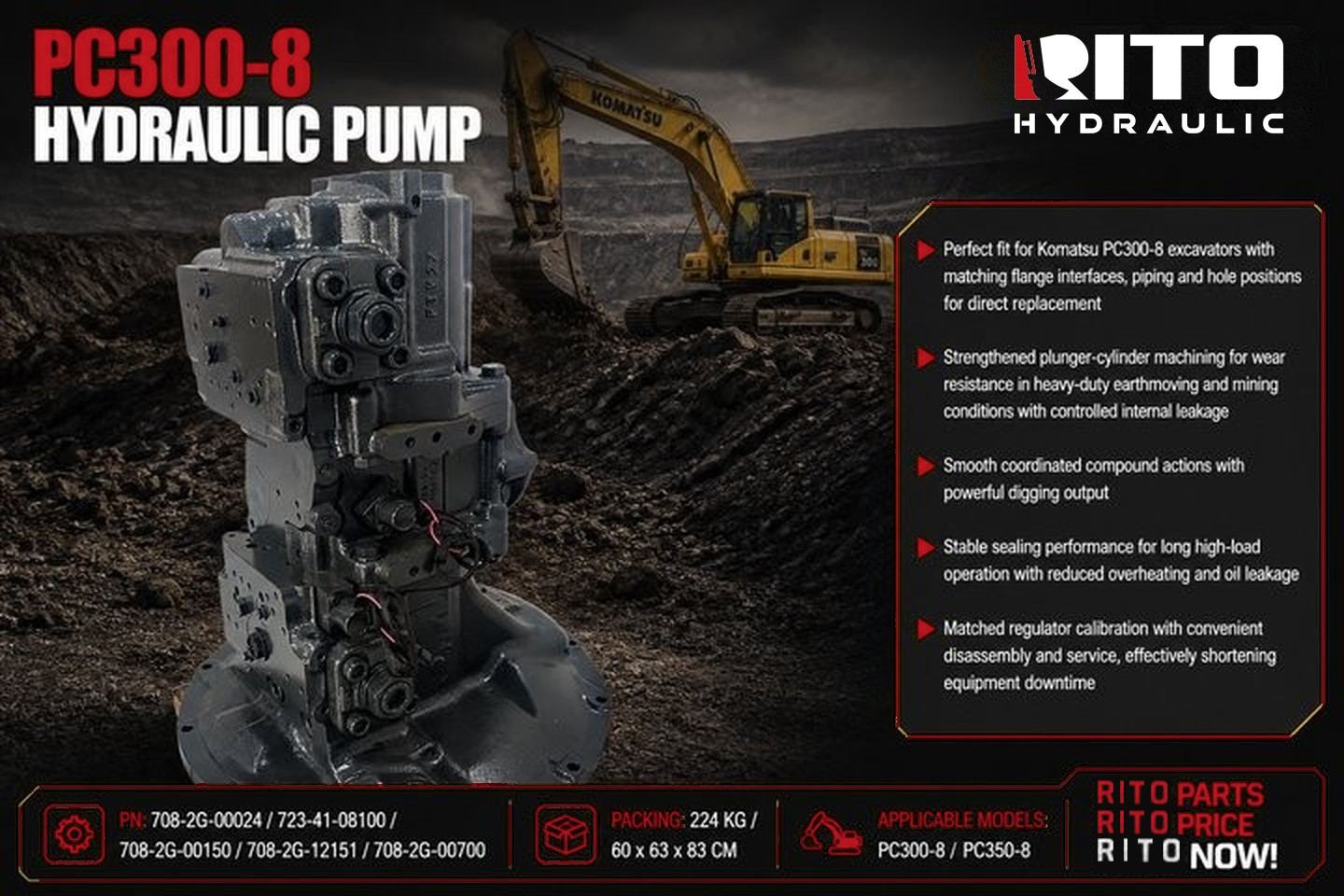
The assembly itself is a substantial item: roughly 224 kg, packed in a 60 x 63 x 83 cm case. At that weight, five minutes of identification is worth far more than the freight on a return.
5. What Must Match for a Direct Replacement
On this class of machine the pump bolts to the engine side and is fed by several substantial pipes. "Direct replacement" is not a marketing phrase — it is a set of machined and positional details agreeing with the original. These are the ones that decide whether the job is a bolt-on or a fabrication exercise:
| Must match | Why it decides the job |
|---|---|
| Mounting flange and hole positions | The unit bolts to the same mounting group as the original; a different pattern cannot be adapted on site |
| Piping positions and sizes | Suction, delivery and drain must reconnect without re-plumbing — re-piping a machine this size is a project in itself |
| Drive coupling and input shaft | The pump must engage the engine-side drive exactly; this cannot be modified |
| Regulator and control arrangement | The pump must accept the machine's control signals as the original did |
| Overall size and weight | Around 224 kg has to go back into the same space, in the same orientation |
Two of those deserve emphasis. Piping position is where "it fits" most often turns out to be false: a pump can bolt up perfectly and still leave a delivery line pointing the wrong way. And the control arrangement is the one that produces a machine which runs, drives, digs — and still feels wrong, because it is being asked to behave in a way its regulator was not set for. That is the subject of the next section.
6. Regulator Calibration Decides the Feel
The regulator is the small control block on the pump that decides how far the pump strokes for a given demand. It is what turns a hydraulic pump into a machine: the regulator reads the load and the operator's demand, and sets the pump's output accordingly.
That is why a correct pump with a wrongly matched or badly set regulator performs badly — and why "matched regulator calibration" is a specification worth reading carefully rather than skipping past:
| If the regulator is not right | What the operator experiences |
|---|---|
| Set to respond too eagerly | The machine feels harsh or jerky; the engine can be dragged down under sudden load |
| Set to respond too slowly | Sluggish, hesitant response — the machine feels lazy even though the pump is new |
| Calibrated for a different build | Compound actions fight each other, the machine is hard to place accurately, and heat builds |
| Correctly matched and set | Smooth coordinated compound actions with the machine's full digging output available |
The practical guidance is straightforward. Ask what the replacement's regulator is set to, and confirm it belongs to your machine's build — not merely to the pump class. Then, after fitting, verify the machine's settings against its specification before condemning anything, and re-check them again after the first working shifts, because settings drift and a pump that was perfect on day one can be misadjusted on day thirty.
This is also why the assembly is described as designed for convenient disassembly and service. A regulator that can be accessed, inspected and re-set without pulling the machine apart is what turns a pump problem from a multi-day event into a planned repair — and on a machine that earns by the hour, that is worth as much as the pump itself.
7. Wear and Sealing Decide the Service Life
Two design details decide how long a replacement pump actually lasts, and both are about holding the line against internal leakage.
Plunger-cylinder machining. The plungers and their bores are the surfaces that seal the pumping action. When they wear, oil slips past them and returns to the case instead of going to the actuators — the machine loses power, and the lost energy becomes heat. Strengthened machining and material at this interface is what keeps the clearances sealing under heavy earthmoving and mining duty instead of opening up early.
Sealing performance. The pump's own seals and joint faces decide whether oil stays where it belongs. Stable sealing means less external leakage, less air drawn in, and less heat — because a pump that has to work against internal leakage is a pump that runs hot. Over long high-load shifts, that difference is the difference between a unit that lasts and one that is back on the bench.
Both properties show up in the same measurement, which makes them worth monitoring rather than assuming. Case drain flow is the pump's internal leakage made visible: a reading that has climbed against your own baseline, taken at the same oil temperature and operating point, is the earliest warning that the plungers and valve plate are starting to let oil through. The method is set out in our guide to reading case drain flow, and it is the cheapest piece of predictive maintenance available on a machine like this.
8. FAQ
Q1: What hydraulic pump does a Komatsu PC300-8 or PC350-8 use?
An HPV140 class variable-displacement main pump, ordered under 708-2G numbers. Both machines share the same pump family, so the class alone does not identify the assembly — the plate on the pump and the machine serial do.
Q2: Why do the same part numbers appear for both PC300-7 and PC300-8?
Because the two generations share the pump family and Komatsu revised numbers across the transition, leaving older references in circulation alongside newer ones. That overlap is the main source of wrong-pump purchases on these machines.
Q3: Is 708-2G-00024 the right number for a PC300-8?
In the market, 708-2G-00024 is listed predominantly against the -7 machines (PC300-7, PC340LC-7, PC350-7, PC360-7), while 708-2G-00700 and 708-2G-00150 are listed for the -8 machines. Treat it as a number to confirm against your own plate, not a decision.
Q4: Is 723-41-08100 a pump number?
No. 723-41-08100 is a main control valve reference, correctly associated with these machines but describing a different component. Main pump numbers sit in the 708-2G series; 723-41 belongs to the control valve.
Q5: What has to match for a direct replacement?
The mounting flange and hole positions, the piping positions and sizes, the drive coupling and input shaft, the regulator and control arrangement, and the physical size and weight. All five must agree for the unit to bolt straight on.
Q6: Why does the regulator matter so much?
Because it decides how much the pump strokes for a given demand. A correct pump with a regulator matched to the wrong build, or set wrongly, produces a machine that is jerky, sluggish or hot — even though nothing is broken.
Q7: What fails first inside this pump?
The sliding and sealing surfaces: plungers and their bores, and the valve plate. As they wear, internal leakage rises, power falls under load and heat rises. Contaminated oil accelerates all of it.
Q8: How do I know the pump is wearing before it fails?
Trend the case drain flow at a fixed oil temperature and operating point. A reading that has climbed against your own baseline means internal leakage is increasing, and it gives you time to plan the replacement.
Q9: Can the pump be repaired instead of replaced?
Where the damage is confined and the unit is properly re-tested, a rebuild can be viable. If wear spans the rotating group and the regulator, a complete matched assembly is usually the lower-risk route — particularly on a machine that needs to keep earning.
Q10: What should I send to get a quotation?
The machine model and serial number, the full plate number from the old pump, photographs of the plate and of the pump from a few angles including the flange and ports, and a note of what the machine does wrong and when.
9. Get Your Pump Confirmed
Send us your machine model, serial number and the full plate number from the old pump — plus a few clear photos and any test readings — and our team will confirm which number genuinely belongs to your build, tell you whether a repair or a replacement is the sensible route, and quote lead time the same day. RITO HYDRAULIC supplies complete, individually tested main pumps, control valves, swing devices and travel motors for Komatsu, Hitachi, Caterpillar, Kobelco, Hyundai, Doosan, Kawasaki and SANY machines — with export packing and a 6–12 month warranty. Replacement assemblies and the wider spare range are grouped under excavator hydraulic parts.
Contact our team or learn more about RITO HYDRAULIC.
- Когда следует заменять бортовой редуктор на Caterpillar 320 GX?
- Как работает главный гидрораспределитель на SANY SY205 или SY215?
- Почему SANY SY500 медленно передвигается на одну сторону? Руководство по диагностике бортового редуктора
- Износ гидравлического насоса PC600-6: как дренажный поток из корпуса указывает на внутренние повреждения
- Почему Kawasaki K3V112DT так распространен на 20-тонных экскаваторах?