
CAT 330GC Final Drive — Which Part Number Fits and What Should You Check Before You Buy?


Автор
Эбби
Компания Guangzhou Rito Engineering Machinery Equipment Co., Ltd., расположенная в Гуанчжоу, Китай, является ведущим производителем и дистрибьютором гидравлических насосов, редукторов, поворотных двигателей и главных регулирующих клапанов для землеройной техники. Мы поставляем оригинальные, OEM-запчасти и высококачественные запчасти для вторичного рынка.
Мы стремимся постоянно делиться своим опытом в области строительной техники и гидравлических систем экскаваторов. Наша цель — помочь вам глубже понять принципы работы и применения оборудования, что позволит вам работать эффективнее, а также продемонстрировать наши профессиональные знания и возможности. Приглашаем вас узнать о нас больше.
Выбирая нас, вы получаете лучшее обслуживание, самые выгодные цены и самого надежного поставщика!
Мари Р. Уинтерс


Quick Answer
Key Takeaways
- Six references are quoted for this one unit — the plate on your old assembly, not the machine name, picks the right one.
- The unit is a planetary reduction with a built-in two-speed auto shift, so it delivers both fast repositioning and climbing force.
- Roughly 351 kg: a machine-assisted lift and a freight decision, not a shelf part.
- Count the flange holes and photograph the plate before ordering — it is the cheapest five minutes of the whole purchase.
- Ask any supplier for a per-unit test report and a clear new-or-rebuilt statement. Price alone tells you nothing about the internals.
- Wide parts supply is the quiet advantage: internals stay obtainable, so a repair remains possible instead of a forced replacement.
Table of Contents
- 1. What This Assembly Is and Which Machines It Serves
- 2. Six Numbers — One Assembly Family
- 3. What to Verify on the Machine
- 4. What to Verify About the Supplier
- 5. Where a Cheap Unit Gives Itself Away
- 6. Confirm Before You Order
- 7. FAQ
- 8. Get Your Final Drive Confirmed
1. What This Assembly Is and Which Machines It Serves
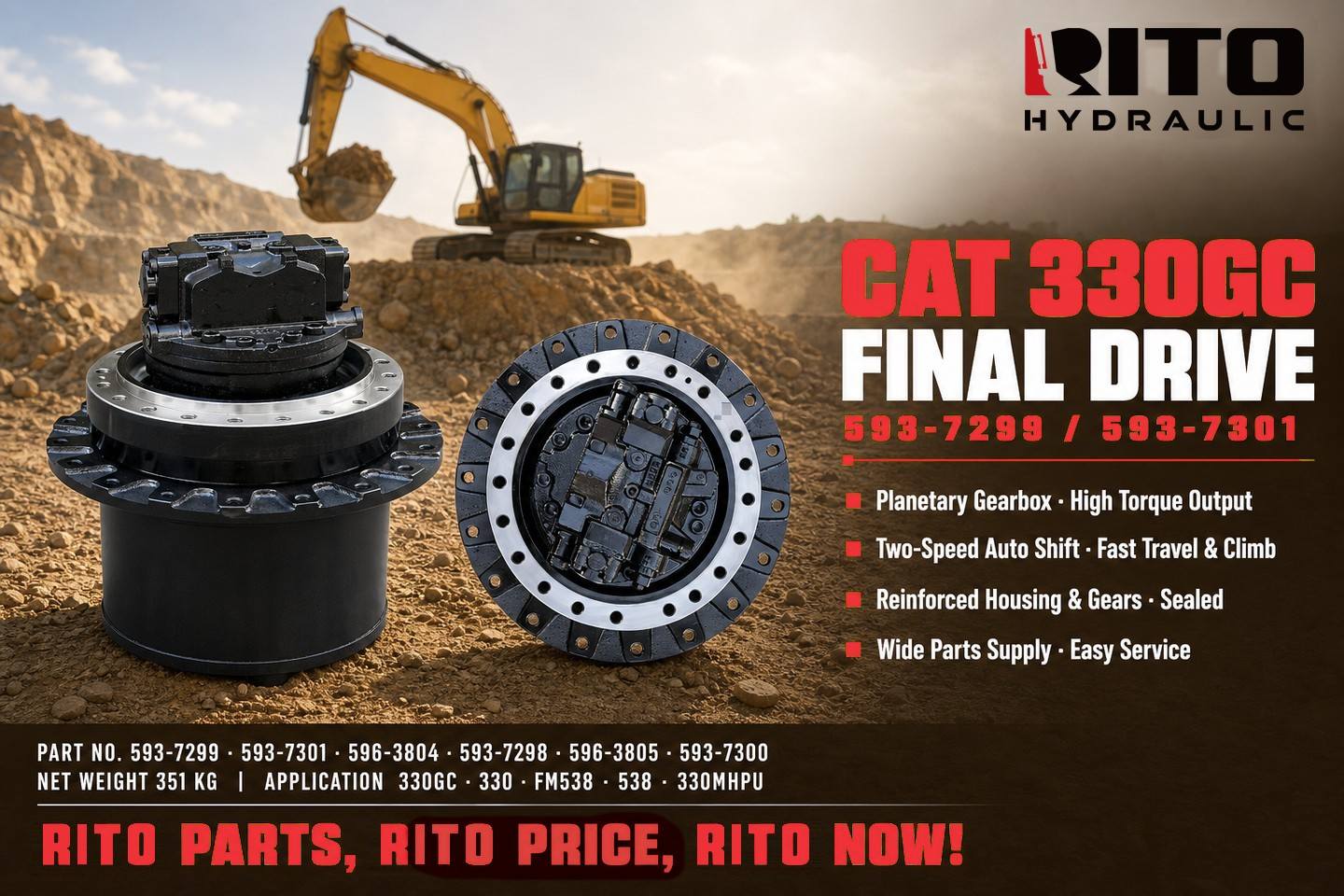
On a 30-tonne class machine like the CAT 330GC, the travel assembly — the final drive — sits inside each track and does three jobs in one bolt-on unit: it turns hydraulic flow into rotation, multiplies that rotation into track-pulling force through a planetary reduction, and holds the machine still with a parking brake.
Two characteristics of this particular unit are worth understanding before you compare prices, because they are what you are actually buying:
| Characteristic | What it means on site |
|---|---|
| Planetary reduction, high torque output | The gearing turns fast rotation into the slow, heavy pull needed to move a machine of this size through rock and mud |
| Two-speed auto shift | High range for travelling the site quickly; low range for climbing and for pulling out of soft ground — the function operators notice every shift |
| Reinforced housing and gears, sealed | The load-bearing structure and the oil-tight enclosure that keep grit and water out of a precision gear train |
| Wide parts supply | Internals stay obtainable across the family, so a rebuild stays possible — see the note on service in section 5 |
That family stretches further than the excavator badge suggests. The same assembly is listed across the 330GC, 330, FM538, 538 and 330MHPU machines — a forestry carrier and a power unit among them. For an owner the practical consequence is good news: a component shared across several machine types stays supported for far longer than a single-model part.
If you are working out how this unit behaves in service, our notes on one-sided slow travel cover the diagnosis side, and the buying logic for the smaller 320 GX is set out in our 320 GX final drive gearbox guide.
2. Six Numbers — One Assembly Family
This is the first place buyers get caught. Ask for a travel drive for a 330GC and you will not be quoted one reference; you will be quoted a group of them, and every seller will sound certain about which one you need.
| Reference quoted for this family | Where it comes from |
|---|---|
| 593-7299 / 593-7301 | The pair most commonly quoted together for the 330GC travel drive |
| 593-7298 / 596-3805 | Quoted in the same listings, and alongside travel-motor references for the same machine |
| 596-3804 / 593-7300 | Further members of the group, reflecting revisions and build differences |
Why so many? Because a machine family is revised over its production life and the references move with it, and because the group also covers the 330, FM538, 538 and 330MHPU applications listed above. Sellers then group the numbers they consider equivalent — but a group in a listing is a commercial convenience, not a manufacturer's statement that the parts interchange.
The rule that follows is short: read the plate on the assembly you are removing and record the full reference, then confirm it against the machine serial. Do not pick the number you happened to see first. On a 351 kg part, this is the difference between a delivery and a return.
3. What to Verify on the Machine
Everything in this section can be done at the machine, with a torch, a phone and ten minutes. It is the "experience" half of the purchase — the part no catalogue and no listing can do for you.
| # | Verify | Why it decides the purchase |
|---|---|---|
| 1 | The plate on the old unit | Read it, photograph it straight-on, and record the full reference — this is the authority, not the model name |
| 2 | Machine model and serial number | The serial identifies the build. On a family this widely shared, it is what separates one variant from another |
| 3 | Flange hole pattern and pilot diameter | Count the holes and photograph the flange face. A unit that bolts up is a one-day job; one that does not is a fabrication project |
| 4 | Sprocket interface and play | The sprocket and its fasteners go back on the new unit — and any play here is evidence of how worn the old one was |
| 5 | Port and drain positions | Photograph the port face so the replacement can be matched without re-plumbing lines on site |
| 6 | Oil condition in the old unit | Metal, silver sheen, milkiness or a burnt smell tells you how much damage is internal — and whether the circuit needs flushing too |
One field habit worth adopting: photograph the plate at the next service while it is still legible. Plates corrode, get painted over and go missing, and a machine whose plate has vanished becomes much harder to source for.
4. What to Verify About the Supplier
Once the machine side is settled, the purchase comes down to a question most buyers ask too late: how do I know the unit on the pallet is what it claims to be? These are the questions worth asking, and what a good answer sounds like.
| Ask | What a credible answer looks like |
|---|---|
| "Is this new or rebuilt?" | A direct answer, in writing. A rebuilt unit is a perfectly respectable purchase — an unlabelled one is not |
| "Is there a test report for this unit?" | A per-unit document, not a general brochure. Testing is what turns "it should be fine" into evidence |
| "What is the warranty, and who honours it?" | A stated term with a named contact — not "we stand behind our products" |
| "Which internals did you replace?" | Gears, bearings, seals and the brake pack listed individually. Vagueness here is the single biggest warning sign |
| "How is it packed, and what does it weigh?" | Answered with a figure — around 351 kg for this unit — because weight drives freight, lifting and damage risk |
| "Can you show the part number on the unit?" | A photograph of the marking on the actual unit going into the crate. This is the cheapest way to prevent a swap |
Two habits make those answers worth something. First, ask before you pay, not after — a supplier's willingness to answer is itself information. Second, keep the paperwork: the test report, the warranty terms and the photographs of the plate. If something does go wrong, those three documents are your entire case, and without them a complaint becomes a conversation about opinions.
5. Where a Cheap Unit Gives Itself Away
Price differences on a component like this are not random. A lower figure has to come from somewhere, and it is almost always one of these five places.
| Where the saving is taken | What it costs you later |
|---|---|
| Worn internals left in place | The unit arrives in a clean housing and still carries the wear that caused the last failure |
| Seal quality cut to the minimum | Dust and water get in early; oil gets out. Both shorten the assembly's life and put heat into the gear train |
| No bench testing | Any internal fault is discovered by you, on the machine, at the worst possible moment |
| Housing refinished, internals not | The paint is the newest thing in the crate — a well-known and expensive illusion |
| Undefined rework scope | Nobody can tell you what was replaced, so nobody can predict how long it will last |
This is where wide parts availability earns its place as a specification rather than a slogan. When internals are obtainable across a machine family, a rebuild can be done properly — gears, bearings, seals and brake components renewed — instead of being a cosmetic exercise. The same family support is what makes a genuine repair possible at all, and our breakdown of the replace-or-repair decision on the 320 GX walks through when that is the right call and when a complete unit is the better spend.
One more consideration belongs in this section: oil discipline after fitting. A correctly rebuilt or new unit placed into a contaminated circuit inherits the same debris that destroyed the previous one. Flushing, filters and clean oil are part of the job, not an optional extra. You can see the practical versions of this assembly in our E330GC travel gearbox listing and the E330GC / E330 final drive assembly page.
6. Confirm Before You Order
Six items turn the purchase into a single round of supply:
- 1. Machine model and serial number.
- 2. The full reference from the old unit's plate — plus a photograph of it, straight-on and in focus.
- 3. The flange hole count and pilot diameter, with a photograph of the flange face.
- 4. Whether the machine is two-speed — it should be, on this model, and the replacement must match.
- 5. Photographs of the ports, drain and sprocket interface.
- 6. What the machine does wrong, and when — both tracks or one; only under load; hot or cold.
Sent together, those six items let a supplier confirm the unit against your machine instead of guessing from a model badge. Sent as "one final drive for a 330GC", they become a coin toss on a part that weighs as much as a small car.
7. FAQ
Q1: What is the part number for the CAT 330GC travel drive?
The assembly is quoted under 593-7299, 593-7301, 596-3804, 593-7298, 596-3805 and 593-7300. Because several references apply, confirm from the plate on the unit you are replacing together with the machine serial number.
Q2: Why are there six numbers for one unit?
Because the machine family was revised over its production life and the same assembly also serves the 330, FM538, 538 and 330MHPU. Old references stay in circulation alongside current ones, and listings group them as equivalents — which is a seller's convention, not the manufacturer's statement.
Q3: How heavy is it, and why does that matter?
Around 351 kg. That weight determines how the unit is lifted, how it is packed and what it costs to move — and it is the reason a wrong unit is so expensive to correct rather than simply returned to a shelf.
Q4: What is the single most important check before ordering?
The plate on your old assembly, read together with the machine serial. Everything else can be confirmed around it, but without those two you are matching on a model name that covers several variants.
Q5: Does the two-speed feature have to match?
Yes. The two-speed auto shift is what gives this unit both fast travel and climbing force. A replacement that does not support the same function will not behave correctly even if it bolts up.
Q6: How do I tell a good rebuilt unit from a bad one?
Ask what was replaced. A credible rebuild lists gears, bearings, seals and brake components individually and comes with a test report. If nobody can tell you the scope of the work, assume the cheapest possible scope was carried out.
Q7: What warranty should I expect?
Look for a stated term — commonly six to twelve months on a tested unit — with a named contact who honours it. A vague assurance is not a warranty, and on a part this size the difference matters.
Q8: Should I buy the whole assembly or just the gearbox?
It depends on the damage. If the motor is healthy and the fault sits in the reduction, a gearbox-level replacement can be correct — provided the motor has genuinely been tested. If wear spans both, a complete unit is the lower-risk route.
Q9: What should be done at the same time as the replacement?
Flush the travel circuit, change the oil and filters, use the correct oil grade at the correct level, and check the other side as well — it has worked exactly the same hours on the same ground.
Q10: What should I send to get a quotation?
The machine model and serial number, the full reference from the old plate, the flange hole count, photographs of the plate, flange, ports and sprocket interface, and a note of what the machine does wrong and when.
8. Get Your Final Drive Confirmed
Send us your machine model, serial number, the reference from the old plate and the flange hole count — with a few clear photographs — and our team will confirm the correct assembly for your 330GC, tell you whether a gearbox-level repair or a complete unit is the sensible route, and quote lead time the same day. RITO HYDRAULIC supplies complete, individually tested travel assemblies, final drives, travel motors, main pumps and control valves for Caterpillar, Komatsu, Hitachi, Kobelco, Hyundai, Doosan, Kawasaki and SANY machines, with export packing and a 6–12 month warranty. Replacement assemblies and the wider spare range sit under excavator hydraulic parts.
Contact our team or learn more about RITO HYDRAULIC.
- Когда следует заменять бортовой редуктор на Caterpillar 320 GX?
- Как работает главный гидрораспределитель на SANY SY205 или SY215?
- Почему SANY SY500 медленно передвигается на одну сторону? Руководство по диагностике бортового редуктора
- Износ гидравлического насоса PC600-6: как дренажный поток из корпуса указывает на внутренние повреждения
- Почему Kawasaki K3V112DT так распространен на 20-тонных экскаваторах?